Bread and Salt
A Gentleman in MoscowBread and Salt is Mikhail Fyodorovich Mindich’s final literary project and the tangible legacy through which Count Alexander Ilyich Rostov encounters his friend’s work after his death. Conceived as a chronological anthology of quotations in which the word bread is repeatedly capitalized and bolded, it brings centuries of writing into contact with the lived meaning of food. Its effect on Rostov is at once intellectual and intimate: the book makes him laugh at its author’s characteristic feistiness, then breaks his composure with a passage about a child’s grave and the sparrows who might visit it.
Delivery and Physical Form
Katerina Litvinova brings the package to Rostov at Mikhail Fyodorovich Mindich’s request. It is rectangular, wrapped in plain brown paper and tied with twine; its weight tells Rostov that it contains a book before he opens it. The modest wrapping gives way to a small leather-bound volume. A simple geometric design is tooled into its cover, with the title at the center. Roughly cut pages and loose threads reveal that the binding was made by a devoted amateur rather than finished as professional work.
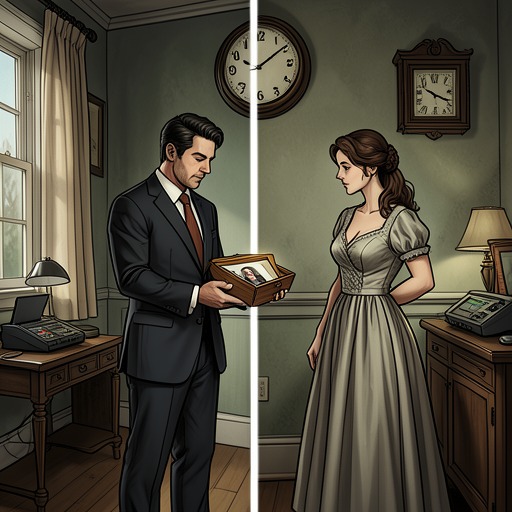
Rostov first handles the book as an object entrusted to him, then discovers how much of his own past it contains. Tucked into the seam of the title page is a photograph taken in 1912 at Rostov’s insistence, to Mikhail’s chagrin. In it, the young Rostov stands in a top hat, with a glint in his eye and a moustache extending beyond his cheeks; Mikhail stands beside him, looking ready to sprint out of the frame. The photograph had remained in Mikhail’s possession all those years. Its place inside the book makes the volume both an anthology and a container for the history of their friendship.
A Chronology of Bread
The book’s organizing principle is simple and exacting: it gathers quotations from seminal texts in chronological order, and in each passage the word bread is set in bold capitals. Its sequence begins with the Bible, moves through Greek and Roman works, and reaches Shakespeare, Milton, and Goethe. Rather than explain the changing significance of bread, the anthology lets one marked word recur across different voices and historical moments. Each quotation remains part of its original work, but the repeated typographic emphasis makes the entries speak to one another.
The Russian literary selections receive particular attention. One passage from Nikolai Gogol’s The Nose describes Ivan Yakovlevich preparing bread at a table before discovering a nose inside the loaf. The grotesque discovery brings the anthology’s central word into a scene of comic shock: bread is not merely named but made the setting for an absurd intrusion. The book also includes material from Fyodor Dostoevsky’s The Brothers Karamazov, including a passage associated with the Grand Inquisitor and a second citation from a scene Rostov had nearly forgotten.
That second passage concerns Ilyushechka, a boy hounded by his schoolmates, who falls dangerously ill and dies. In his last request, he asks his father to crumble a crust of bread on his grave so that sparrows will come and he can hear them, glad not to be lying alone. The anthology’s recurring emphasis on bread thus reaches beyond appetite or literary motif: here it is bound to a child’s wish for company after death. Rostov, who had been turning the pages slowly and laughing at the project’s audacity, breaks down when he reads it.
The Final Entry and Its Historical Irony
Bread and Salt does not continue its survey into the present. Its citations end in June 1904 with sentences cut from a letter by Anton Chekhov, written in Berlin. Chekhov describes enjoying the food there and praises the bread; the passage concludes that people who have never been abroad do not know how good bread can be. Mikhail had removed these sentences from the letter years earlier. Their appearance as the book’s last entry makes the old act of cutting part of the work’s structure: the anthology ends at the point where an earlier act of censorship had altered the source.
Rostov considers the possibility that Shalamov, or Shalamov’s superiors, had insisted on the omission during the hardships of the 1930s, on the assumption that Chekhov’s praise of food abroad could provoke discontent or ill will. The passage’s return exposes the instability of that calculation. By the time Rostov reads it, the comparison no longer seems to describe a Russian deprivation measured against European plenty. The irony, as he understands it, is that the Russian people now know better than anyone in Europe how good a piece of bread can be. The book’s long chronology therefore closes not with a timeless literary flourish but with a particular observation whose meaning has been changed by history and hunger.
A Friend Preserved in a Book
After Katerina Litvinova delivers the volume, she dismisses Rostov’s thanks: she has come at Mikhail’s request. When Rostov offers to remember him, she answers that he should. Once she has gone, Rostov sits quietly before untying the package. The photograph and the anthology then make the request concrete. Mikhail is present not as an explanation supplied by another person, but through the choices, quotations, and traces he left inside the book.
The passage from The Brothers Karamazov draws Rostov into grief for his friend: a generous yet temperamental man who had only a brief moment in time and, like Ilyushechka, was not inclined to condemn the world for its injustices. Rostov also weeps for himself. His friendships with Marina, Andrey, and Emile, his love for Anna, and Sofia’s arrival in his life have not replaced the particular witness Mikhail represented. With Mikhail’s death, the last person who knew Rostov as a younger man is gone. Katerina’s instruction to remember him consequently carries a double weight: the book preserves Mikhail’s voice, while its photograph preserves the two friends at an earlier point in their lives.
Rostov takes a deep breath and tries to regain his composure so that he can read the final pages of his friend’s final discourse. When he closes the book, however, he does not go straight downstairs to join the others. He remains alone in his study, lost in thought. Bread and Salt ends, within the novel’s scene, not by resolving his mourning but by giving it an object to rest upon: a hand-bound volume that gathers public texts into a private farewell.